


Three conditions must be met at once for a country to be a true maritime power. It has to be able to fight at sea. It has to move cargo at a global, commercial scale. And it has to be able to build and repair the ships that do both without asking anyone’s permission.
Few countries manage all three. The United States has the navy and the yards, but no globally competitive merchant fleet. Britain has a weakening navy and sold most of the yards. Germany builds ships but has no navy to project power. China holds all three outright, and Japan and South Korea arguably do as well.
France holds all three. It is the only country in Europe that does, and it is the only country other than the United States operating a nuclear-powered aircraft carrier with catapults. What follows is the shape of its maritime position — and then the three places where it needs shoring up in the next decade.

Figure 1- The French Maritime Empire
To follow along with the analysis, find the interactive map of French Maritime Power here.
Part One — Three Pillars
One: a navy that can go anywhere
As of 1 April 2025, the Marine nationale had 136 hulls in commission across 31 homeports, displacing roughly 413,950 tons at full load, with five further warships and one uncrewed surface vessel in trials.
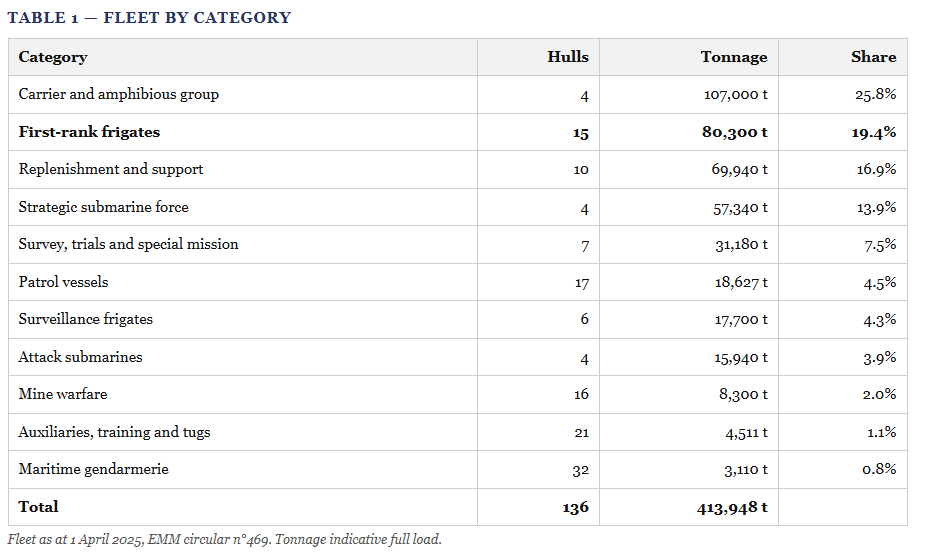
Four of those hulls carry the deterrent. The Triomphant-class boats maintain a continuous at-sea patrol that has not lapsed since 1972, powered by reactors designed and built by France, and a fifth-generation replacement — SNLE 3G, the lead boat named L’Invincible by the President in March 2026 — is under construction at Cherbourg for commissioning in 2036. One hull carries fixed-wing airpower: the Charles de Gaulle, nuclear-powered, catapult-equipped, and outside the United States Navy, the only carrier in the world that is both.
The carrier strike group is expeditionary strike power. The reach behind it is wider still: France holds a sovereign exclusive economic zone of 9,529,864 square kilometers across 18 zones, with a further 571,983 square kilometers under overlapping claims. Metropolitan France accounts for 3.7 percent of it. No other country holds sovereign waters and sovereign territory in the Atlantic, the Indian Ocean, and the Pacific simultaneously, with the bases, airfields, and homeports to go with them.
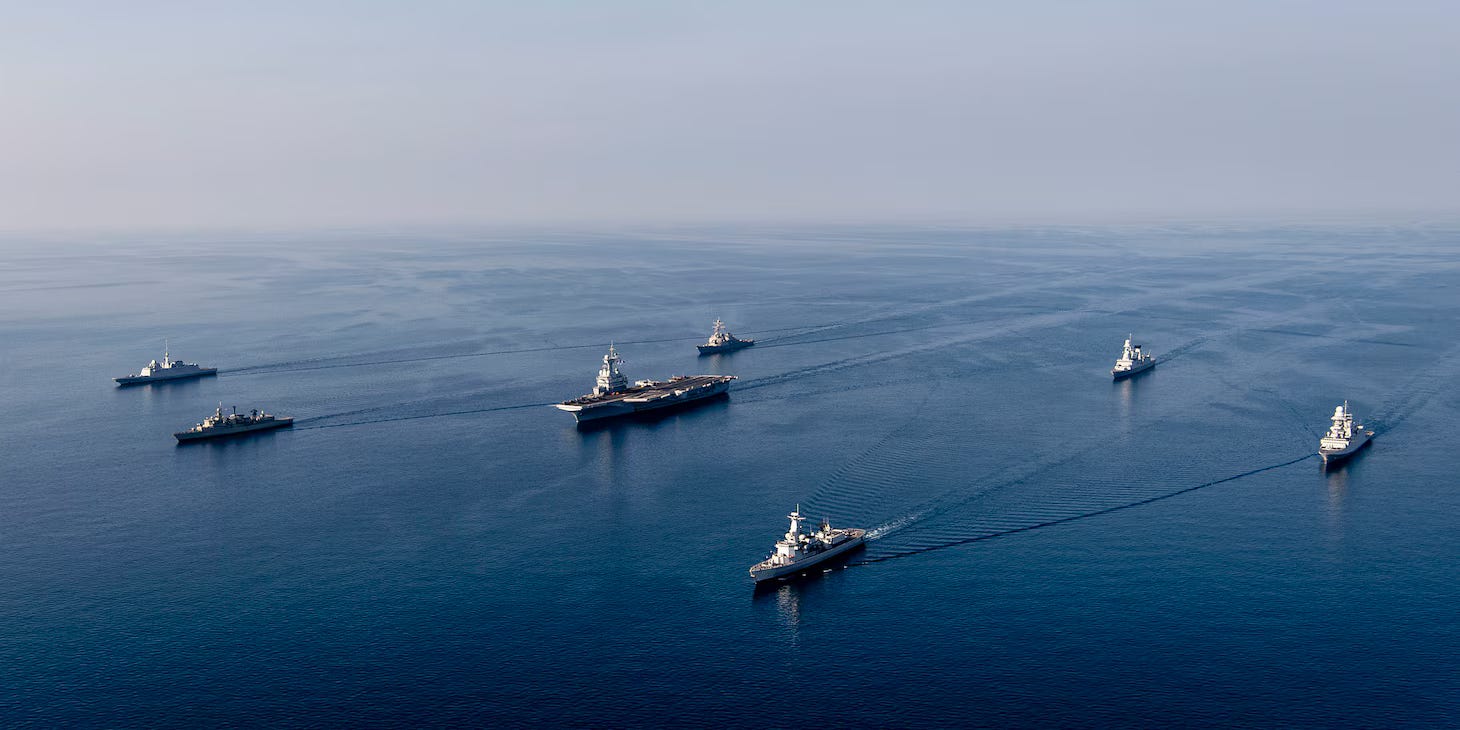
That distribution is backed by permanent presence in high-traffic sea lanes. Ten maritime chokepoints carry the bulk of seaborne energy and containers. France has basing near four — Bab-el-Mandeb through Djibouti, Hormuz through Port Zayed in Abu Dhabi, the Strait of Dover through Cherbourg, and the Mozambique Channel through Mayotte and Réunion. Djibouti holds around 1,500 personnel and is becoming the headquarters for French operations in Africa; Abu Dhabi holds around 700 across three sites and hosts the ALINDIEN command. Almost no European state has a permanent armed presence on any chokepoint. France has two of the most contested ones.
And the fleet is being replaced rather than run down. Twenty-three hulls are on order across eight programs. The next-generation carrier was greenlit in December 2025 — 78,000 tons, 310 meters, two K22 reactors, three electromagnetic catapults — for assembly at Saint-Nazaire starting in 2032 and service starting in 2038.
Two: a commercial fleet with global weight
The commercial side is not subordinate to the naval one. It brings revenue to the national treasury that funds the navy, and, in terms of global market share, it is the stronger of the two.
CMA CGM is the third-largest container line in the world. It operates 683 ships and more than four million TEU of capacity — about 12.7 percent of everything afloat in the container trades — behind MSC and Maersk and ahead of COSCO, on revenue of $55.5bn in 2024. It is a French family firm headquartered in Marseille. No other European country outside Denmark and Switzerland has anything comparable, and neither of those has a navy to protect maritime commerce.
The ports have moved with it. HAROPA — Le Havre, Rouen and Paris operating as one authority — passed three million TEU in 2024, a rise of 18.7 percent. Marseille-Fos handles roughly 70 million tons a year and supports some 41,500 jobs. Port Réunion moves about 375,000 TEU and handles 99 percent of the island’s trade, which is what an overseas EEZ looks like when it is working commercially rather than sitting on a map.
Then there is the part of the commercial maritime power few consider. Sixty-two submarine cables land on French sovereign territory across 86 landing stations, and 37 of them have a French owner somewhere in the consortium. Orange Marine operates six cable ships and a survey vessel — roughly fifteen percent of the world’s cable-laying fleet — and has laid more than 288,000 kilometers of cable. The modern economy runs on undersea cables, and cables are laid and repaired by a small global fleet of specialist ships. France owns a sixth of that fleet.
Three: a sovereign industrial base
Twenty-four sites make up the French maritime industrial base: ten with French state-majority ownership, nine French-private or employee-owned, and five with a foreign parent.
What matters is which ten are state-held. Naval Group is 62.49 percent state-owned, with Thales holding 35 percent, employs 15,261 people and turned over €4.31bn in 2024. Chantiers de l’Atlantique is 84.3 percent state-owned, employs 3,913 people, with more than 7,000 on-site daily, including subcontractors, and turned over €2.54bn. Between them, France builds ballistic-missile submarines, nuclear attack submarines, nuclear aircraft carriers, frigates, amphibious assault ships, replenishment vessels — and the largest cruise ships in the world, in the same 900-meter dock that will assemble the next carrier. There is no foreign veto anywhere in that list.
Exports keep the yards full. Naval Group delivered Kimon, the first FDI frigate for the Hellenic Navy, in December 2025, without interrupting French hulls. The order book also covers Egypt, the United Arab Emirates, Romania, Malaysia and Morocco. Foreign navies pay to keep Lorient working between French orders, and they amortize the capital sunk into the yard across more hulls than the French fleet plan alone would ever justify. Export work is not a sideline to sovereign capacity. It is what makes sovereign capacity affordable.
One qualification belongs here rather than in a footnote. Sovereignty over newbuild does not extend to ship repair. The largest commercial dry docks in France — at Brest, Dunkerque and Marseille — are Dutch- and Italian-owned.

The same concentration that makes the base sovereign also makes it narrow. Cherbourg is the only yard in France that can build a submarine. Toulon is the only site capable of refueling and overhauling the nuclear carrier. The 900-meter dock at Saint-Nazaire is the only one capable of assembling the next carrier. And Lorient is the only yard in France that builds surface combatants — not one of several, the only one.
What is changing
From November 2023, French frigates in the Red Sea spent four months doing something the fleet had not done at that intensity in decades: sustained air defense, at sea, against cheap mass. Drones and anti-ship missiles fired by a non-state actor at merchant traffic transiting Bab-el-Mandeb, night after night, at a unit cost several orders of magnitude below the interceptors used against them.
Nothing in that engagement suggested the French Navy was badly built. Its ships worked, its crews performed, and the Alsace intercepted three ballistic missiles. What it did was apply pressure to three specific things at once — how many escorts there are, how much firepower each one carries, and how long the support system can hold at tempo. Those are the three places France is brittle. None of the three is visible on a map.
Part Two — Three Places France is Brittle
One: hulls
Fifteen first-rank escorts, 80,300 tons, 19.4 percent of fleet tonnage. Six multi-mission frigates of the Aquitaine class, five light stealth frigates of the La Fayette class, two Horizon air-defense frigates and two enhanced air-defense FREMM. A sixteenth, the first Amiral Ronarc’h-class frigate, is in trials.
France plans to hold at fifteen rather than grow. The FDI class replaces the La Fayettes one for one — five ordered against five retiring, the fifth ordered in March 2026 for delivery in 2032. Admiral Nicolas Vaujour put the format to the National Assembly’s defense commission in October 2024: « Le format actuel est de quinze frégates de premier rang. »
That ceiling is a policy choice, not an industrial limit. Naval Group says Lorient can build two FDI a year. The French order book calls for five in seven years. Holding the escort force flat through 2032, while the threat that emptied its magazines persists, is a mistake.
Fifteen escorts cover a carrier and amphibious group of four hulls and 107,000 tons — more tonnage than the escorts themselves — along with a 9.5 million square kilometer EEZ and standing commitments in the Gulf and Indian Ocean through ALINDIEN. They are split across two coasts, five at Brest and ten at Toulon.
Lorient can build two FDI a year. France is buying five in seven years. The limit is the plan, not the yard.
Sovereign capacity has concentrated France’s shipyards. Cherbourg, Toulon, Saint-Nazaire and Lorient each hold a monopoly on something, and a single site is a single point of failure in war. But that is a resilience risk, not the reason the escort force is fifteen. The yard has headroom. The plan does not.
Two: magazines
Over those four months in the Red Sea, two French frigates fired 22 Aster surface-to-air missiles. A standard Aquitaine-class FREMM carries sixteen. There is no way to reload a vertical launch cell at sea, in any navy in the world, so a frigate that empties its magazine leaves the theatre to refill it.
The published figure of “fifteen first-rank frigates” also conceals how differently those ships are armed. Sylver launch cells come in lengths. An A43 cell takes the Aster 15, with a reach of roughly 30 kilometers. An A50 takes the Aster 15 or the longer-ranged Aster 30, at roughly 120 kilometers. An A70 takes the naval cruise missile and no air-defense round at all.
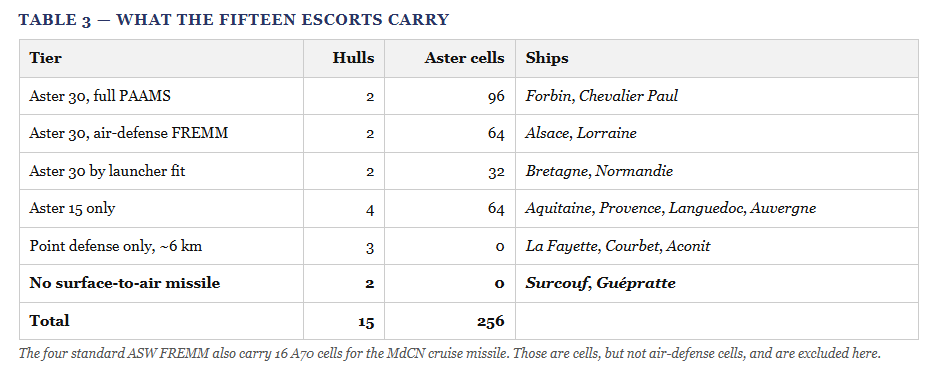
Six of France’s fifteen first-rank escorts can fire an Aster 30. Four carry the short-range round only. Three of the La Fayettes traded an aging Crotale for Mistral 3 launchers with a range of about six kilometers, and the other two — Surcouf and Guépratte — had the Crotale removed and received nothing in its place.
The long-range naval air-defense force of the French Republic is six hulls and 192 cells.
France reached this conclusion. Under the 2024–2030 military programming law, the Aster magazine of the FDI class was doubled from sixteen cells to thirty-two: with hulls four and five built to the new standard, the third upgraded on entering service, the first two retrofitted afterward. The supply side moved with it — MBDA raised Aster output by half between 2022 and the end of 2025 and plans to double 2026 production again, with a second assembly line in Italy.
France was quick to realize it needed to amend its munitions plan.
Three: surge capacity
French naval readiness is good. Admiral Vaujour told the defense commission on 16 October 2024:
« La Marine peut être fière d’obtenir 75 à 80 % de disponibilité des frégates en parc. »
Seventy-five to eighty percent availability across the frigate inventory beats most European navies and is not a weakness. Note the precise phrase — « disponibilité des frégates en parc ». Some reporting glosses this as availability within ten days’ notice, a fair reading but the outlet’s framing rather than the Admiral’s, and neither formulation is the same thing as fully mission-capable with every system working.
What matters is how the rate is bought. The Admiral named the mechanisms himself in the same session:
« Nous avons donc mis en place les bâtiments à double équipage. Cela a permis d’augmenter les jours de mer. »
« Nous avons fait un effort colossal pour le MCO. Nous avons poussé les industriels à s’améliorer. »
Dual crewing increases sea days per hull by assigning two crews to one ship. Continuous maintenance replaces long cyclical refits. And the Senate’s review of military maintenance records that the verticalized support contracts notified in 2022 and 2023 — more than two billion euros, with frigates the largest single line — hand inventory management to the contractor on a just-in-time basis, precisely to avoid the cost of holding stock.
Every one of those is an efficiency measure that removes slack. Dual crewing means there is no reserve of ships in port or sailors on shore duty ready to rotate into combat. Just-in-time spares mean there is no shelf of parts. Continuous maintenance means no yard period can be deferred to buy time, because none is already being deferred.
France is not brittle due to non-availability. It’s brittle because it cannot surge. A fleet can be simultaneously well-maintained and unable to fight for long.
A navy sized for presence and forward deployment in peacetime is right to buy availability this way, and France has bought a great deal of it. What the arrangement does not answer is what happens in the second month of an escalating shooting war.
Conclusion
France is a strong maritime nation by every structural measure that matters. It fields the only nuclear catapult carrier outside the United States Navy and a deterrent patrol unbroken since 1972. It owns the third-largest container line on earth and a sixth of the world’s cable-laying fleet. It builds submarines, carriers, frigates and the largest cruise ships afloat in yards it controls outright. It holds sovereign water in three oceans and permanent bases on two of the world’s most contested straits. Few countries hold that combination; no other European country holds any version of it.
The three brittle places are narrow and addressable by comparison, and two of them are the direct price of the strengths. A sovereign escort yard is a single escort yard. A fleet optimized for standing presence is a fleet without slack. Only the magazine problem is a straightforward gap that France is already correcting.
Not addressed in this article, French sealift for expeditionary land operations. French land forces can be moved by sea only with difficulty. The amphibious force is real — three Mistral-class ships, 64,500 tons, able to land a battalion with its vehicles. Everything heavier rides on merchant hulls, and there are almost none. Of roughly 1,245 French-controlled ships, 21 are roll-on/roll-off and 35 RoPax: 4.5 percent, averaging 19 and 28 years. Requisition runs through the TRAMIN mechanism under article L2213-5 of the Code de la défense. Owning the world’s third-largest container line does not produce a sealift fleet.
For educational purposes only. Always do your own research.
Sources
Fleet, tonnage, EEZ, industrial base, and program figures are computed from the mapped dataset and the Marine nationale ship list (EMM circular n°469, fleet as at 1 April 2025). EEZ areas are from the Marine Regions World EEZ dataset (VLIZ), legal limits. Program and basing data are current to mid-2026.
Readiness and fleet format
Opex360, 19 October 2024 — reporting on the audition, and the source of the ten-day gloss
Sénat, rapport r24-004 — Maintien en condition opérationnelle des équipements militaires
Red Sea operations and magazines
Meta-Defense, 27 March 2024 — Red Sea after-action review on French frigate air defenses
Militarnyi — Alsace intercepts three ballistic missiles in the Red Sea
Defense News, 11 January 2024 — French Navy defends use of million-euro missiles against drones
Naval News, November 2025 — France to double Aster missile capacity on FDI frigates
Meta-Defense, 16 April 2026 — with 32 Sylver A50 silos, the fifth FDI changes its operational status
Zona Militar, 18 October 2025 — Alsace Aster 30 intercept of a supersonic sea-skimming target
Defense News, 26 March 2026 — MBDA to double Aster air-defense missile output in 2026
MBDA — on track with its acceleration of Aster missile production
Class armament
Aquitaine — 16 × Sylver A43 plus 16 × A70
Alsace — 32 × Sylver A50, A70 cells deleted
Alert5, 9 October 2018 — A50 installed on the last two FREMM
Horizon class — 48 × Sylver A50 within PAAMS
La Fayette class — no vertical launch system; Sadral / Mistral 3 on three hulls
Interesting, and also slightly surprising that Europe still contains a state which is a maritime power.
Odd that one says that about Europe but, hey, its 2026 and the colonial era ended over six decades ago.