


Google’s Pacific network runs more than 80,000 kilometers of undersea cable. It lands at 37 points across 16 territories, and it reaches levers of national power well beyond a search engine. It is a US strategic asset held by a private company. It operates with the permission of several governments, and renewed great-power competition has made it matter more.
Follow along with the map here.
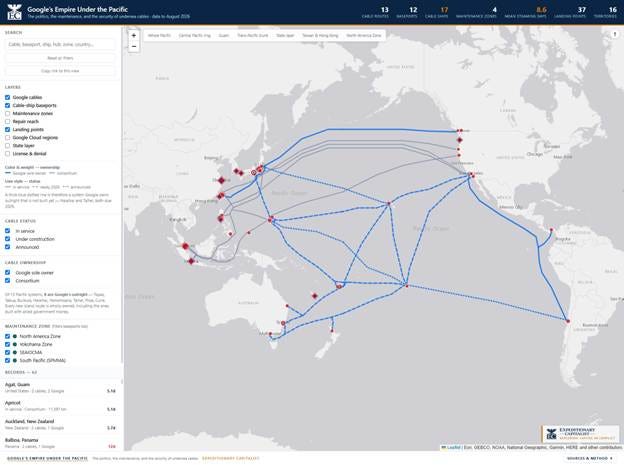
The whole network. Thirteen Google systems across the Pacific, 37 landing points in 16 territories. Solid lines are in service, dashed lines are under construction, and dotted lines are announced.
The modern economy runs on data. Corporations, militaries and private citizens all depend on it. Between satellites and undersea cables, the world is connected as never before. What gets less attention is who owns that infrastructure, and what placement and access it buys them.
While Google is its own actor, with its own capital and its own interests, it is also subject to geo-economics. The United States determines who may supply the equipment and where the next interconnection points will be located. Australia influences and funds the island routes and reserves a say over who else builds in Papua New Guinea. A proposed landing in Hong Kong was refused outright. Many parties exercise leverage, and all want the benefits undersea cables bring.
The asset
Of thirteen Google systems in the Pacific, eight are Google’s entirely: Topaz, Tabua, Bulikula, Halaihai, Honomoana, Taihei, Proa and Curie.
The public record understates the significance of this ownership. Google announced Bulikula as a cable connecting Guam and Fiji. It runs 20,354 km and lands at eight points in five territories — Fiji, French Polynesia, Guam, the Northern Marianas and Hawaii. A single cable, in this case, is significantly more than it sounds once mapped.
Much of the network is being built. Four systems — Tabua, Bulikula, Honomoana and Proa — are under construction, roughly 51,700 km between them, commissioning segment by segment through 2026 and beyond. Their US landing points come up across 2026, and the island landings follow. When these cables will be complete is uncertain. Proa has already slipped from the first quarter of 2026 to late 2026 or early 2027.
Why satellites do not replace cables
Roughly 99 percent of intercontinental traffic runs undersea, and satellites carry well under one percent. Starlink’s own network update puts the entire constellation at “~450 Tbps — Cumulative Capacity Launched To-Date,” while Google’s Topaz carries 240 Tbps of design capacity on a single cable — about half the entire constellation. Low Earth orbit is not a redundant layer for subsea capacity but rather a thin emergency margin, and Tonga spent 38 days living on it after the Hunga Tonga eruption cut its cable in January 2022. This network flow has significant implications for the US government, especially for communications with key allies and US territories in the region during wartime. Adversary attacks on the cable network would no doubt precede conflict. Public records show that that risk is certainly on people’s minds.
The kill switch
Google’s US–Taiwan segment operates under a National Security Agreement with the Departments of Justice, Homeland Security and Defense. The provisional agreement is public in full.
• Google must be able to interrupt traffic within 24 hours of notice.
• The administrator with exclusive authority to de-provision the segment must be a US citizen who is not a dual citizen, approved by all three departments.
• Every network operations center touching it must be physically in the United States and staffed by screened personnel.
• Google must file a restoration plan for the wet infrastructure.
The agreement also directs Google to “pursue diversification of interconnection points in Asia, including but not limited to Indonesia, Philippines, Thailand, and Vietnam.” The two final agreements, both dated 16 December 2021, are docketed but withheld.
Capacity is reported to the government, not to the public. Under 47 CFR §43.82 every licensee files an annual Circuit Capacity Report. In the 2024 edition, Curie, Echo, FASTER, and PLCN are all marked with asterisks — “filer requested confidential treatment” — while the note below confirms that the published regional totals include the withheld figures.
The United States has the power to turn Google’s private cable on and off and required a repair plan as a condition of the license. This requirement highlights the importance of the undersea cable network as national infrastructure with military implications.
Who paid
The White House fact sheet “Delivering on the Next Generation of Innovation and Partnership with Australia,” dated 25 October 2023, states that the United States “is engaging with Google to scale a series of significant private-sector consortium investments in subsea cables.” Nine Pacific Island countries are named as beneficiaries: the Federated States of Micronesia, Kiribati, the Marshall Islands, Nauru, Papua New Guinea, the Solomon Islands, Timor-Leste, Tuvalu and Vanuatu.
Monetary support comes from multiple governments: $65m combined from the United States and Australia.
Three Google-built domestic cables are funded through Australia’s Pukpuk Treaty commitments, signed in Canberra on 6 October 2025 and in force from 8 July 2026 — Papua New Guinea’s first alliance and Australia’s first in seventy years. Annex B, Article 4(5), requires the parties to “mutually determine any involvement in or contribution to that critical infrastructure by others.” Article 11(1) permits Australian Defense personnel to install and operate their own communication systems in Papua New Guinea, including cables.
Every new island route is wholly Google’s. The cable landing licenses show it holds assets through one company per jurisdiction — Starfish Infrastructure in Delaware is the licensee on all six new systems, with seven further subsidiaries behind it, one for each jurisdiction the cable touches. All are indirect wholly-owned subsidiaries of Google LLC. This information is all publicly disclosed, with every entity named in a public license.
In this case, Allied development finance is capitalizing private assets. State money, private title, geo-economics.
New builds are under Google’s sole control
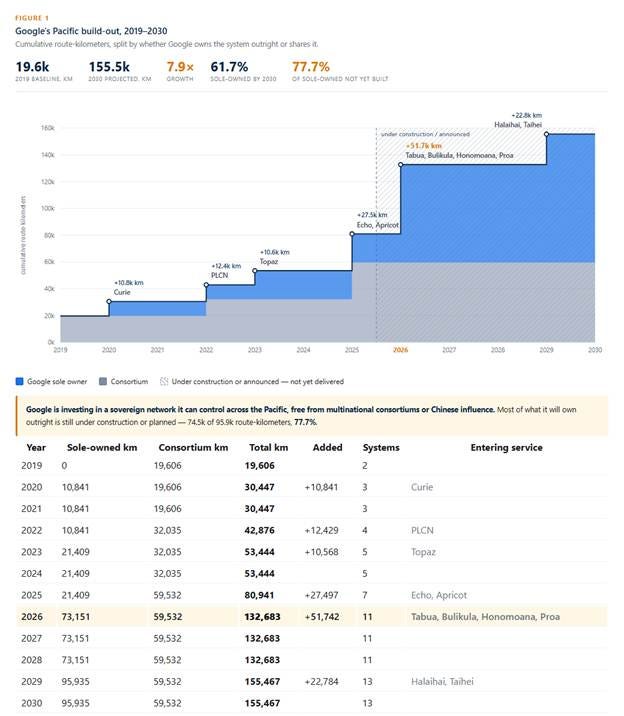
Figure 1. Cumulative route-kilometers, split by whether Google owns the system outright or shares it.
Consortium mileage plateaus at 59,532 km after 2025 with no plans to grow. Every kilometer from 2026 onward — 51,742 km in that year alone — is wholly Google-owned. This shift demonstrates that the ownership model has changed.
Readers can see the owner lists as a decoupling strategy due to China’s rise and the US pivot to the Pacific. In 2010, Unity was a six-way consortium. FASTER in 2016 had China Mobile and China Telecom as co-owners. PLCN and Echo are Google and Meta. Apricot adds only allied carriers. Everything from 2026 is Google alone.
Given the foreign ownership, FASTER could likely not be licensed today. China Mobile was denied §214 authority in 2019, China Telecom Americas had its authority revoked in 2021, and China Unicom Americas in 2022.
The corollary matters for the island states. Under the consortium model, national carriers took equity. Under this one, they do not. Announcements name FINTEL, APTelecom, and Vocus as Tabua partners, but the license states that Yellowfin holds 100 percent of the Fijian portion. The island states are landing parties and customers, not owners.
The Hong Kong issue
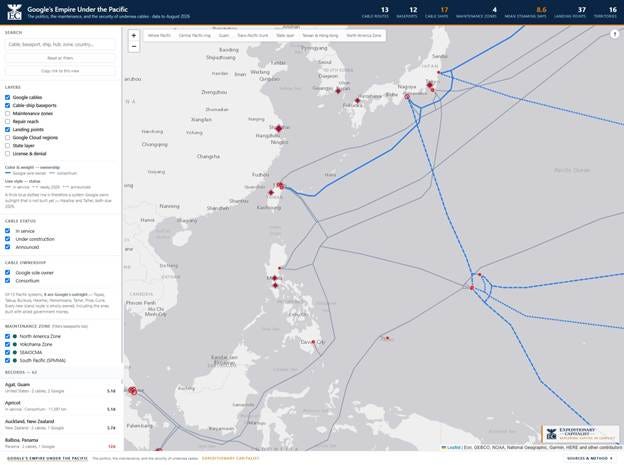
The license layer. Hong Kong carries three filed-and-never-built systems; Taiwan carries four that were built.
Google filed for three Hong Kong cables and built none: PLCN, HK-G and Bay to Bay Express.
On 17 June 2020, the White House, through the NTIA, recommended the FCC partly deny PLCN — as to its Hong Kong connection and as to its foreign owners, Hong Kong-based Pacific Light Data Communication and “China-based ultimate parent entity Dr. Peng Telecom & Media Group.” It recommended granting the US–Taiwan and US–Philippines portions, which contained no PRC-based ownership, on the condition that mitigation agreements be in place. The applicants withdrew in August 2020 and refiled without Hong Kong. The system entered service in 2022 on its Taiwan and Philippines legs.
Subsequent rules codified the case. The FCC’s Order of 7 August 2025 defines “foreign adversary,” places Huawei, ZTE, and HMN Tech on the Covered List, and triggers presumptive disqualification for a Chinese stake below 10 percent.
In this way, Google did not choose its Pacific geography. Due to US government intervention, Taiwan inherited the traffic; and the security agreement then directed where the next interconnection points would be located.
Challenges with repair and sustainment
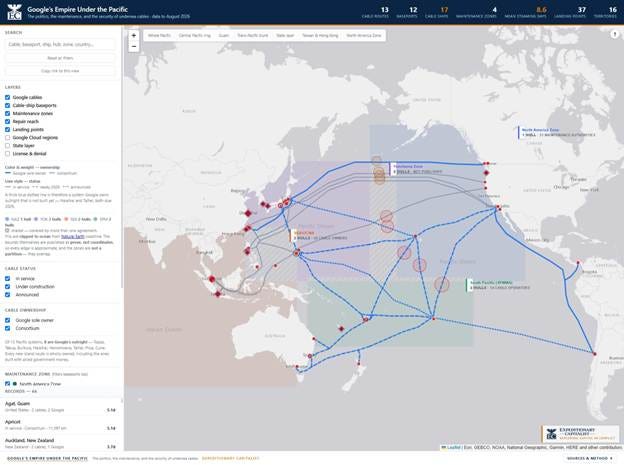
The four Pacific maintenance zones, with the worst-served point on each route marked. Zone bounds are published as prose, so the fills are approximate and they overlap.
In the event of a natural disaster or sabotage, Google’s undersea network cannot be repaired quickly.
The ICPC registry lists 17 cable ships across 12 baseports in the whole Pacific basin. One covers the entire South Pacific — Reliance, at Noumea. One covers the Pacific coast of the Americas — Global Sentinel, at Portland, Oregon, itself a hundred miles up the Columbia River. No cable ship is based in Samoa, Fiji, Guam, Hawaii, or French Polynesia, and none is based anywhere in South America.
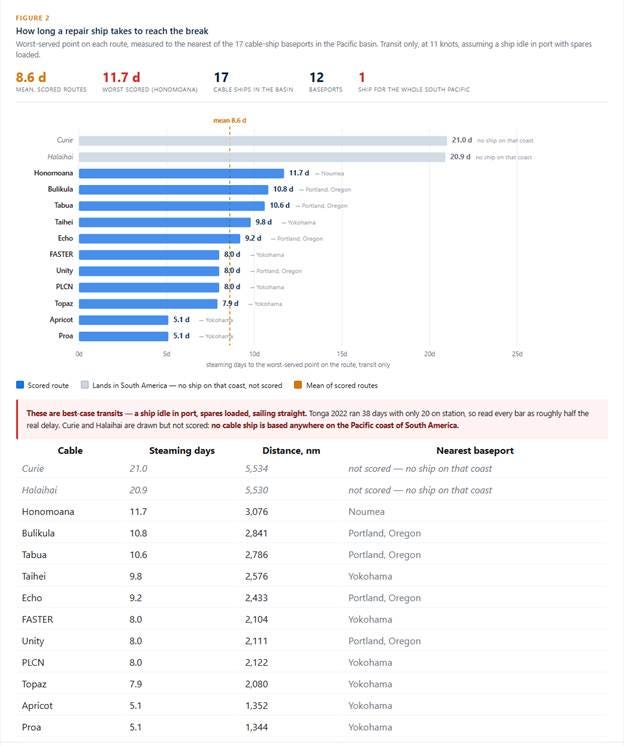
Figure 2. Steaming days to the worst-served point on each route. Transit only, at 11 knots, assuming a ship idle in port with spares loaded.
Every route here is sampled every 50 km along its real published geometry from TeleGeography; each sample is measured to the nearest of those 17 baseports, and the worst sample on the route is reported — converted to days at 11 knots. The mean across the eleven scored routes is 8.6 steaming days. Tahiti, the densest island node in the network, is 9.5 days from the only ship in the South Pacific.
Those numbers are a best-case scenario. They assume a ship in port, idle, loaded, and sailing straight, and they exclude mobilization, spares, weather windows, permits, and any queue behind other faults. Tonga’s outage lasted 38 days, with only 20 on station — roughly 18 days of overhead on top of a modeled transit of a few days.
There is redundancy in the networks that mitigates some risk. Bulikula carries five spare branching units, and its license reserves one for Tuvalu’s own Vaka system: designed-in capacity for landings that do not exist yet. But the island nodes are stacked rather than diverse. Papenoo and Faratea, both on Tahiti, each carry three Google systems. Guam takes 18 distinct cables across five landing points. Route diversity on a map is not diversity on the seabed when the routes converge on the same island.
Additionally, Google does not own or operate the existing cable ships. Three of the four Pacific maintenance zones are party to the Pacific and Indian Ocean Cable Maintenance Agreement, under which a zone hit by simultaneous faults can call for vessels from another — and a cable owner buys into an agreement rather than commands a vessel. The North America Zone — Alaska to Mexico and out to the mid-Pacific — carries one dedicated maintenance vessel against 31 owner-operators. The South Pacific agreement, which covers more than 51,000 km of cable for 14 operators, is not a party to it.
Google has bought redundancy in the cable and not in the capacity to fix it. This lack of a repair fleet is a capital decision it owns and could fix to ensure network survivability.
What four ships would buy
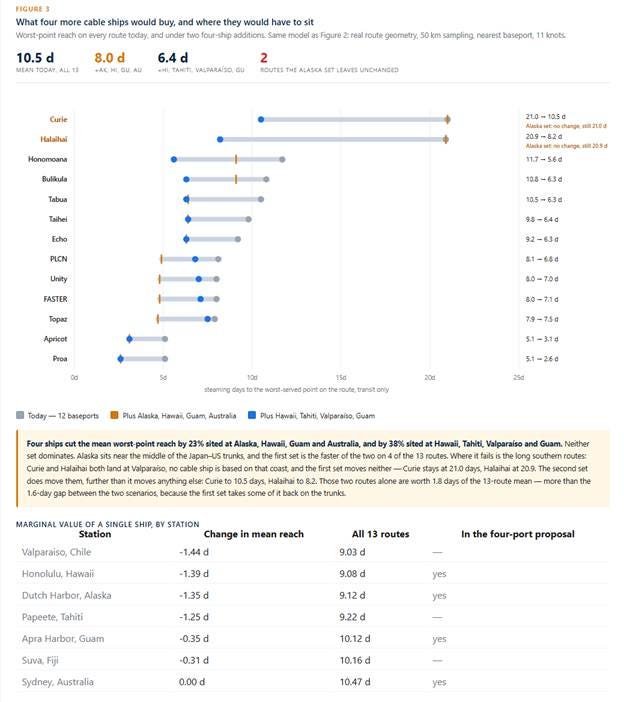
Figure 3. What four more cable ships would buy, and where they would be homeported.
The obvious answer is for Google to buy its own repair ships. Four hulls would be a six percent increase in a world fleet of 63. The repair reach model demonstrates that baseport selection is critical to reducing risk.
Four ships at Alaska, Hawaii, Guam, and Australia cut the mean worst-point reach by 23 percent, from 10.5 days to 8.0 days. Four at Hawaii, Tahiti, Valparaíso and Guam cut it by 38 percent, to 6.4 days. Neither set dominates: Alaska sits near the middle of the Japan–US trunks and is the faster of the two on four of the thirteen routes. But the first set never reaches Curie or Halaihai. Both land at Valparaíso; no cable ship is based on that coast, and the first set moves neither of them. A ship at Sydney changes nothing on any route, because every worst point is already nearer an existing baseport. The question for Google is where it sees the greatest risk, whether man-made or natural.
Even if Google buys four hulls, a ship is not a full repair capability in itself. It needs a spares depot with the right cable and jointing kit beside it; a capability Google should also consider.
The bottom line
The undersea cable network is real power, and it is genuinely Google’s — an impressive data empire. It is also an asset the United States licenses, conditions, funds through allies, and has already redrawn once. It cannot be repaired quickly, and satellite fallback will not replace its capacity. Google owns the cables. It does not own the ocean, the ships, or the permissions, and in a contested Pacific those may decide whether owning the cables means anything.
For educational purposes only. Always do your own research.
For more of my work, check out this article on French Maritime Power:

They don't need repair boats, they need a modern Navy and military response teams. It seems obvious to me that Goldman Sachs, Blackrock, Google, MSFT, Meta, Amazon and more will need to collectively build private, modern military protection and response teams to counter sabotage and kinetic action. I have little doubt that the US government will be coerced into helping pay for and support this quasi mercenary force. Perhaps Google will stage a naming rights contest for their first cruise missile, may I suggest the G-missile to stay on-brand?